

Abstract:The global Active Power Filter (APF) market is undergoing a significant transformation in 2026. As industrial electrification accelerates and nonlinear loads continue to proliferate across manufacturing, data centers, and renewable energy installations, the demand for more intelligent, compact, and efficient harmonic mitigation solutions has reached an unprecedented level.
Industry Overview
The global Active Power Filter (APF) market will undergo major transformation in 2026. Booming industrial electrification and rising nonlinear loads across manufacturing, data centers and renewable energy projects have greatly increased market demand for smarter, compact and high-efficiency harmonic mitigation solutions.
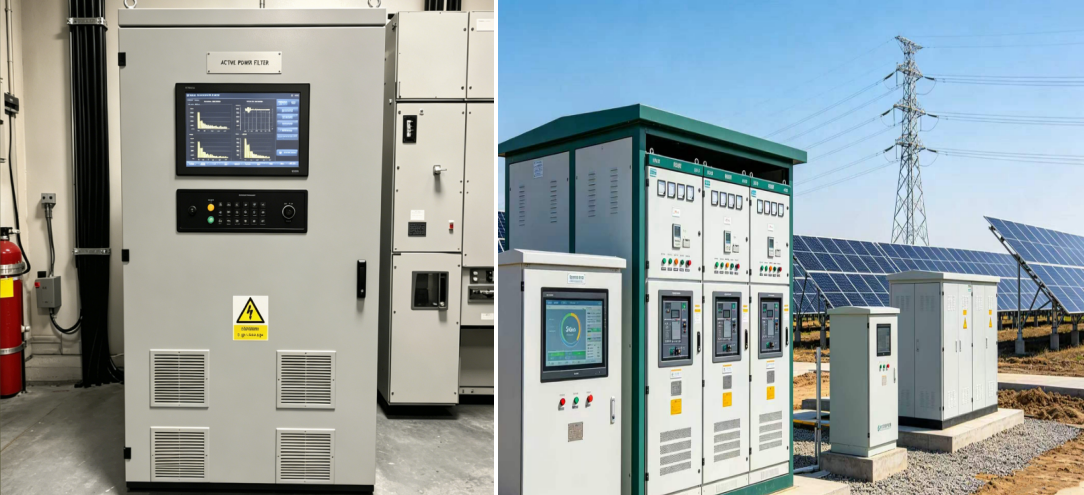
Modular Design Becomes New Standard
Traditional centralized APF systems are limited in scalability, maintenance and space utilization. In 2026, mainstream manufacturers will widely adopt rack-mounted, hot-swappable modular APFs, delivering core advantages:
l Stepless capacity expansion from 50A to 600A to match actual load growth
l Online module replacement with zero system shutdown
l 40% smaller footprint than conventional units
The modular design is highly suitable for data centers and semiconductor factories with strict uptime and space requirements.
Intelligent Control Enables Predictive Governance
New-generation APFs have upgraded from passive real-time compensation to intelligent predictive control, equipped with AI analysis, cloud monitoring and adaptive grid optimization functions. These capabilities support remote diagnosis and predictive maintenance, effectively lowering users’ overall operational costs.
Wide-Bandgap Semiconductors Boost Efficiency
SiC and GaN devices achieved 22% penetration in APF inverters in 2025, doubling the 2021 level. Higher switching frequencies enable more compact hardware and precise elimination of high-order harmonics (13th–25th), solving critical power quality pain points in modern industries.
| Metric | Traditional IGBT | SiC‑Based APF |
|---|---|---|
| Switching Frequency | 10‑20 kHz | 50‑100 kHz |
| Response Time | 20‑40 ms | <5 ms |
| Efficiency | 96‑97% | >98.5% |
| Heat Dissipation | High | Reduced by 30% |
Core Application Scenarios
APF market growth in 2026 is mainly driven by four key sectors:
l Data Centers: Complex harmonics from AI computing and cooling systems make APF+SVG the standard configuration for large-scale facilities above 10MW.
l EV Charging Networks: 150kW–350kW DC fast chargers generate severe low-order harmonics, driving stricter grid compliance standards in Europe and North America.
l Renewable Energy: APFs are widely deployed at grid connection points to eliminate transient harmonic distortion from solar and wind inverters and meet grid codes.
l Semiconductor Manufacturing: High-precision production requires THD below 3%, boosting demand for high-performance APFs with ultra-low residual distortion.

Market Forecast
The global APF market is projected to grow from USD 7.2 billion in 2025 to USD 8.6 billion in 2026, with a 20% year-on-year increase. The Asia-Pacific region dominates the market with over 45% global share, benefited from rapid industrialization and renewable energy development.